|
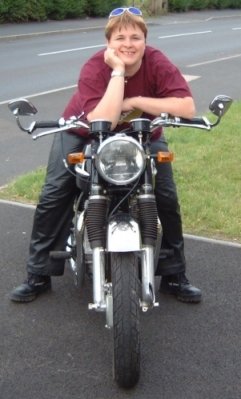
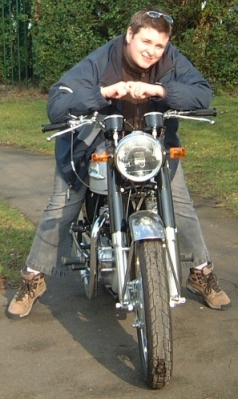
of giving up in my search. I didn't know my dad had decided to custom build me a shortened and simplified 650SS. Every time I returned home to visit, he'd have me look over the bikes he was building for other people. I fell in love with a 650SS he was building for Chris Masey. I'd often tell him that if this was my bike, I'd have this done, or that done, or this bit stainless and that bit painted black. I didn't twig that this bike was being build for me, even when I'd go back the next time and the modifications I'd suggested had been done - I just though that this Chris Masey must have had good taste too. Chris Masey actually turned out to be my 1997 ChrisMas…ey present! It kept the works mechanics tittering for months, sometimes I think some men spend too much time around petrol fumes.
Have you ever fancied a ride out on your bike and thought that you just can't face the prospect of having to haul it out of the garage, heave it onto it's centre stand and then have to jump up and down on the kickstart for what seems like an eternity, all whilst getting hot and sweaty because the beast won't start. I imagine that there are those of you out there that enjoy this sadistic pastime, but me, I'd rather get straight on and off I go. I have considered getting a bike with an electric starter, but I actually do enjoy the encouraging words and smiles I get from the usually male onlookers, when I kick the bike up with one swing of its kickstart. Sometimes I do wonder though, if they are gathering to hear the roar of the bike, simply wanting to watch a woman bring it to life, or perhaps it is the prospect of watching me getting hot and sweaty trying………it's the latter isn't it, I feel guilty disappointing them all now!
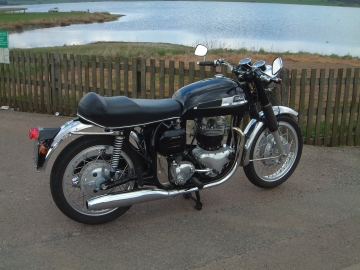
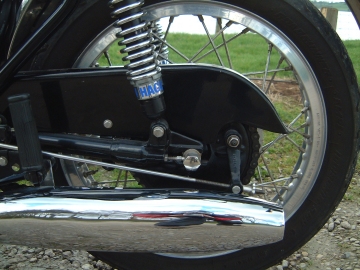
My bike has had a few very easy modifications to make it work better for me. If you have a restoration project that is still a box of bits, or even if you have a concours condition bike, you could benefit from making a few small modifications to your bike to make it easier to get going, run like a dream without a single flutter in it's heartbeat and then easier to stop too. Although my bike is a Dominator, many of the modifications I have on my bike, can be made to your classic too. If you are shrinking or just short to begin with like me, then you might like to consider some of the following modification to reduce the ride height of your classic. Firstly, my seat has been lowered, approximately an inch of the padding has been removed from under my bum, (which has more than enough of it's own natural padding - ahem). I think this scalloped seat makes the bike look super sporty and gives it the feel of having a king and queen seat, (although my boyfriend always complains that I don't give him enough of the seat when he's on the back). Secondly, my forks have been shortened. At 21 3/8", my forks are ½" shorter than on a standard 650ss, this is done by using shorter stanchions, (21 3/8" long rather than 21 7/8" long) and also shorter damper tubes, (7" long rather than 7 ½" long). When you shorten the front, it is often a good idea to shorten the back too, my Hagon shocks are ½" shorter than standard and come in at just 11.4" long. So with an inch reclaimed from the lowered seat, another half inch from the smaller wheels and half inch from shorter forks and shocks, my bike has a 2" lower ride height than a standard 650SS. It doesn't sound a lot when I put it like that, but 2"'s is the difference between getting your feet flat on the floor and being on your tip toes. This can make a big difference when you are at traffic lights, on uneven ground and especially when you are getting the bike out of the crowded garage. There are some implications to making things shorter though, I have had to have my side stand and centre stand shortened because I am using 18" wheels rather than the standard 19". This change in wheel size also meant a 21:10 speedo drive from a BSA needed to be installed on my bike. If this speedo drive wasn't used, then my speedo clock would not give me the correct speed that I am travelling at and I'd think I was are going faster than I actually am. Though in some cases for some people, this if probably not a bad thing!
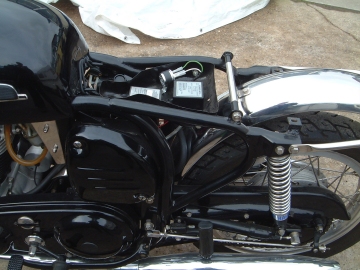
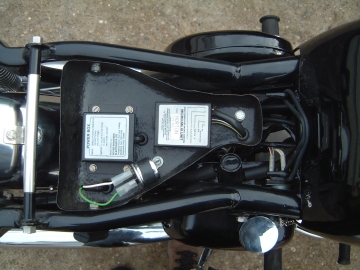
My bike is a 1964 650Ss, this is a change over year meaning I have wider forks and a steering lock. Thankfully, this particular year of 650SS manufacture was already designed to use 12 volt electrics. If your bike doesn't currently use 12V, then you should consider switching. With 12V electrics you can use a Wipac quadoptic halogen headlamp, which will get you seen by day and night. I now use a special 5 watt halogen parking bulb as well, I know from past experience that if you don't have a backup and your headlamp bulb blows at night, then you are in for a long wait for the rescue services. My parking light is now so bright that I can get home with it at night if I had too. You might suggest that a spare headlamp bulb can be carried in the tool tray under the seat, but the only tool I'll ever need to carry is my RAC card, just in case. Even if my tool tray had not been filled with my modern electronics, I would not bother carrying any tools other than my multi tool anyway, I am no mechanic and would probably do more harm than good.
My bike has a magneto replacement unit fitted (063066), which uses a Boyer electronic ignition and two 6 volt coils run in parallel, (to give 12 volts). The Boyer electronic ignition incorporates an electronic advance and retard instead of the old mechanical hit and miss type. This gives a smoother spark and more even running. It also means that you have two positive sparks, instead of one positive and one negative as on a magneto. The ignition timing is always absolutely the same on both cylinders. Standard magnetos generally only provide sparks within three to five degrees of correct and competition magnetos are still only between two to three degrees of correct. I will never have to mess about with setting the points (not of course that I would ever have had to, even if I had any, men have their uses, other than mowing the lawn and buying the drinks). I also have a Boyer power box which replaces the rectifier, zener diode, 2MC capacitor and assimilator. Running with a power box means that I could start the bike with a flat battery, if I forgot to turn the lights off. Power boxes also simplify the electrics, as there is less to go wrong and less fault finding if something does.
In keeping with modern improvements, I have had indicators fitted to both of my bikes. I didn't originally have indicators on my Daytona, but I found I couldn't turn as quickly with only one hand to steer with. Fitting the indicators took just a few minutes and they wired straight into my existing wiring loom. When the 650SS was built, indicators were automatically included because I'd asked for them to be added to my Daytona. For safety reasons, I believe indicators are the way to go on all classics and they are very simple to fit with a basic electrical knowledge, both of my bikes have very small discreet indicator sets that don't distract from the bikes classic good looks. It is always a good idea to incorporate an indicator warning light on your headlamp as well, just in case you forget to turn them off. I have found this invaluable.
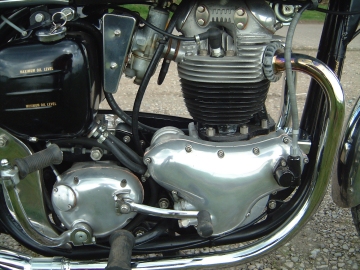
Many people are turned away from owning and riding classic bikes, especially Nortons, because of the problem of oil leaks and wet sumping. Well, I can tell you here, no word of a lie, my bike does neither. I have a high ratio primary belt drive conversion fitted to my 650SS, this makes the bike super easy to start and when it is warm, you can even start it with your hand. A high ratio kit works by turning the gearbox more with each engine revolution so in the reverse direction, each kick of the kickstart turns the engine less than normal, but it is easier to do. This conversion makes use of the Commando clutch, I have 5 plain steel clutch plates and 4 surflex fibre clutch plates fitted. Using surflex plates and binning your old bronze sintered plates, makes such a difference to the weight of the clutch lever, I can pull mine in with just one finger. Some of this clutch lightness is also due to having levers with 7/8" pivot centres, this is a really simple modification to make. Next time you are out on your bike and your hand starts to ache from all the gear changes, just remember how easy it could be and make the change. Another major advantage of the primary belt drive conversion is that it runs dry of oil. There is no oil at all in the primary drive, making the setup a lot lighter and with no oil present, it can't leak out can it? Having the primary running dry means you can also release some of the tension on the clutch spring, without it slipping. Releasing this tension significantly lightens the clutch lever.
As I said earlier, wet sumping is an issue many riders have found with their classics. There are four simple steps that have been followed to eliminate that potential problem on my bike. When all are used together, your problem should be solved forever, meaning more time can be spent riding your bike rather than emptying the sump and refilling the oil tank. Firstly, you need to use the correct Monograde oil (SAE 50 in summer and SAE 40 in winter). Secondly, you need to leave your pistons on compression, to do this, slowly press down on your kickstart about an inch or so, until it reaches the top of the effective swing. This has the effect of raising your pistons and the big end journals to the top of the barrel and so oil has further to go before it can drain out. Thirdly, an anti-drain valve can be fitted inside your timing cover, (AFTER the oil pump), this prevents the seeping of oil down onto the bottom of the
crankcases (this requires a modification to be done to your timing cover -
we need your timing cover to do this modification - if you have a
Commando, then it is simpler to just fit a new timing cover - please check
with us first if your Commando can use the new style timing cover that
comes complete with the modification already done, this is a cheaper
option for some commandos than having the mod done to your timing cover). It is important to point out here, that this is NOT the dangerous type of anti-drain valve, which is fitted by some people into the oil feed line above the crankcases. Anti-drain valves fitted into oil feeds, always cause oil starvation to the big ends for a brief time when starting the bike. If you use a tap instead and forget to turn it on, it will totally blow up your engine. If these three steps have failed to solve your problem, then you probably have a faulty oil pump. Oil can flow backwards through the oil pump if it is in need of attention, most oil pumps can be repaired and restored quite simply - mine was. The fourth step, is to have o-rings fitted to your oil pump shafts to stop oil draining from the feed to the scavenge side.
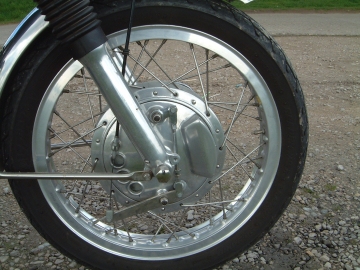
Most of the modifications have been added to make the bike start and run well. One of the most important modifications however, is to make it stop well too. Dominators came with single leading shoe brakes, (SLS), as standard. My 650SS has been fitted with the top of the range twin leading shoe brake, (TLS), this retains the classic looks, but improves the braking significantly. There are four types available, I have the best that you can get. Mine has an air scoop to keep the brake cool, thus preventing the fading you get if the brake shoes get too hot. Mine also has an internal stiffening kit installed. A stiffening kit helps prevent warping of the brake plate that can occur whilst braking, thus meaning more surface area of the brake shoe comes into contact with the brake drum. Using a TLS rather than an SLS dramatically increases your chances of stopping and not hitting the "sorry I didn't see you".
By fitting an external oil filter like mine, not only are your bike services greatly simplified, but you can also use detergent oil. Detergent oils help flush your system of the metallic impurities that you will always get when metal moves against metal. It doesn't matter how good your engine is, or how fantastic your oil is, there will always be wear whenever you run the bike. Better for the rubbish to get caught by the oil filter, magnetic sump plug or magnetic gearbox plug, than floating around your engine. If you don't use an external oil filter then it is best to stick to non-detergent oil, it is not good to flush impurities through your system if you have nothing to catch them.
I am really lazy and I don't like getting dirty. Every time it came around to oil change time, I'd take my bike to my dad for him to sort it out. The main reason was that he has a hydraulic bench, so he can crank it up high and stand some chance of not getting oil all down his arm, when taking the sump plug out. This was the excuse I used for ages. I did mention on countless occasions, that if he designed a system whereby I could take the sump plug out without getting covered in oil, then I'd do my own oil changes at home. You can imagine my surprise and resulting chagrin, when after a routine service, a brand spanking new sump plug was installed on the bike, complete with small central magnetic drain plug. I now do my own oil changes at home. I hate to admit, oil changes are incredibly easy to do now I have a small controlled dribble from the sump, rather than a huge oily gush straight down whichever arm I choose for the deluge. The wonders of modern technology, it amazes me how something so simple and small can solve a problem most people just put up with. Most of the modifications that have been made to my bike I do take for granted because they were already present when I got the bike. The fitting of the magnetic sump plug is probably my favourite modification because it was a solution to a problem that I had personally encountered and grumbled about. You would be amazed at how much swarf the magnetic plug can catch too, my 650SS doesn't create much at the moment because it's only done a few thousand miles, but I have watched the removal of other people's very spikey furry examples!
In the purist's eyes my 650SS is nothing more than a mongrel, whilst I own it it will never win a concours award, I am happy with that. My bike encompasses many modern improvements to make it work smoother and safer, that's what makes it so rideable. Don't overlook riding your classic bike because it is getting too heavy or high to ride, with a few small modifications it can remain a fantastic ride. |